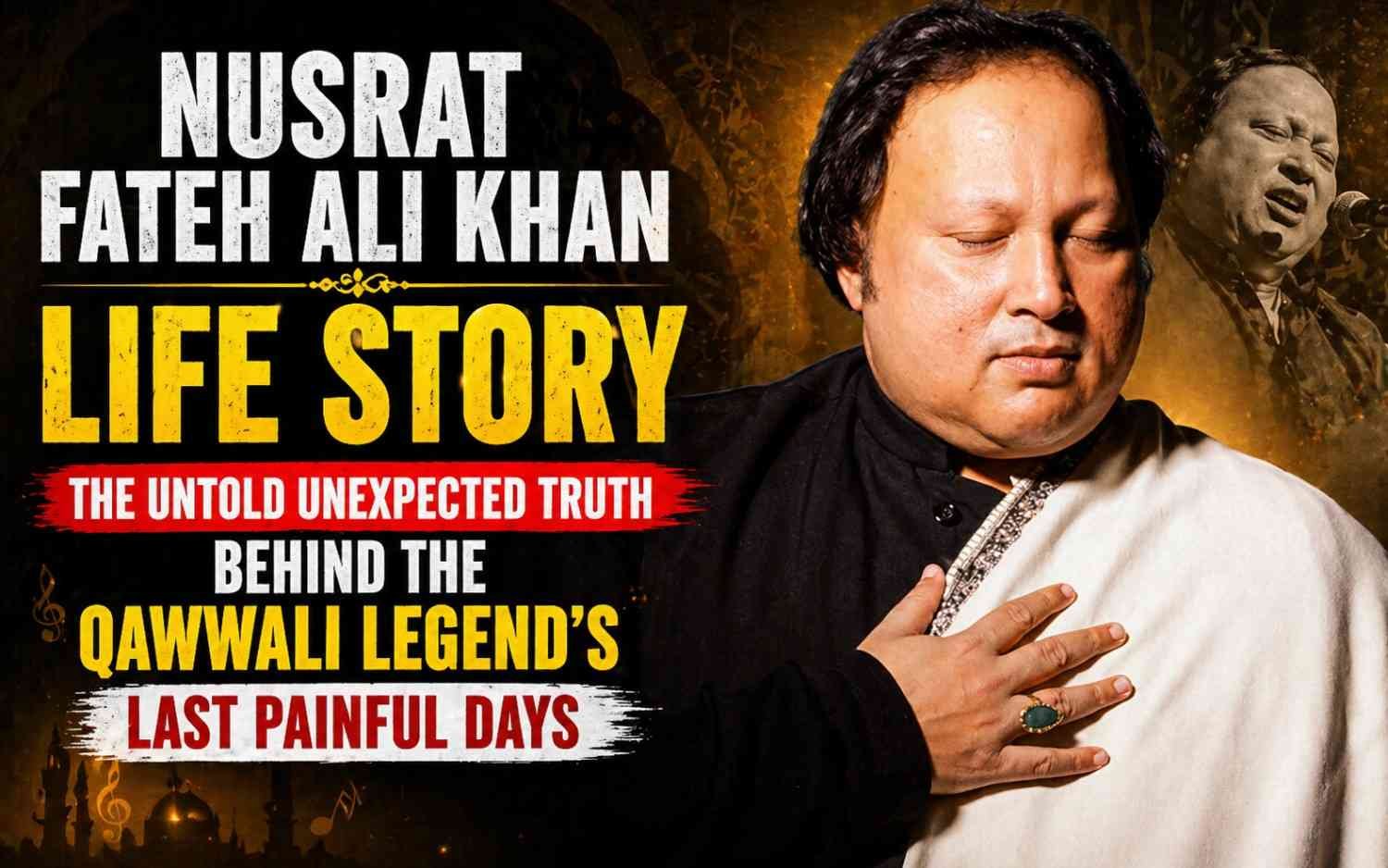
In the realm of spiritual music, one voice still echoes across continents more than two decades after it fell silent. Ustad Nusrat Fateh Ali Khan — affectionately called “Shahenshah-e-Qawwali” (King of Qawwali) — didn’t just sing; he transported millions into a divine trance. His powerful, improvisational style blended ancient Sufi poetry with raw emotional intensity, making qawwali a global phenomenon.
The viral YouTube biography “Melodies of Legend: Nusrat Fateh Ali Khan Biography” has touched emotional narration of his journey — from a shy boy in Faisalabad to an international icon whose final days were marked by unimaginable physical suffering. This article captures the key revelations and heartfelt details straight from the video’s powerful storytelling.
Born into a 600-Year Musical Legacy
Nusrat Fateh Ali Khan was born on 13 October 1948 in Lyallpur (now Faisalabad), Pakistan, as Pervez Fateh Ali Khan — a name later changed to Nusrat on the advice of a spiritual guide. He was the fifth child and first son of legendary qawwal Fateh Ali Khan and belonged to a family with over six centuries of qawwali tradition. His father, uncles Mubarak Ali Khan and Salamat Ali Khan, and the entire household lived and breathed Sufi devotional music.
Yet, his father initially resisted letting young Nusrat follow the family vocation. In an era when qawwali artists often faced low social status, Fateh Ali Khan dreamed of his son becoming a doctor or engineer. Nusrat showed early signs of exceptional musical talent, but it was destiny — and a father’s eventual acceptance — that set the stage for history.
The Turning Point: A Father’s Death and a Divine Calling
Tragedy struck in 1964 when Nusrat’s father passed away. At just 16, Nusrat performed at the funeral, delivering a soul-stirring qawwali that left everyone stunned. The video beautifully narrates how this moment became the young boy’s “dream encouragement” — a spiritual push from his father beyond the grave. From that day, Nusrat dedicated his life entirely to qawwali.
He officially began leading the family qawwali party around 1971, after years of rigorous training under his uncles. His unique ability to improvise verses on the spot, blend classical raags with devotional ecstasy, and deliver high-pitched sargams (vocal runs) soon earned him legendary status in Pakistan.
International Stardom: From Pakistan to the World Stage
Nusrat’s big break came in the late 1980s and early 1990s when British producer Peter Gabriel discovered him. Collaborations with Gabriel’s Real World Records introduced qawwali to Western audiences. Hits like “Mustt Mustt” (with Massive Attack), performances at WOMAD festivals, and albums such as Shahbaaz and Devotional Songs made him a global superstar.
Hollywood took notice too — Nusrat’s voice featured in films like Dead Man Walking and Natural Born Killers. He performed for world leaders, collaborated with Eddie Vedder, and even helped Pakistan’s cricket team win the 1992 World Cup by lending his voice to motivational anthems. The video highlights how this “shy boy from Faisalabad” mesmerized audiences from London to Los Angeles, proving that pure spiritual music knows no borders.
Personal Life, Family, and Quiet Struggles
Behind the spotlight, Nusrat led a relatively private life. He married his cousin Naheed in 1979; they had one daughter, Nida. The biography touches on his progressive side — he encouraged women to learn music at a time when it was uncommon in traditional circles.
Yet the “untold unexpected truth” the video reveals is the heavy personal toll his fame and intense performances took. Constant touring, diabetes, and failing health began to catch up with him in the mid-1990s. Despite doctors’ warnings, Nusrat refused to slow down, believing his music was a divine mission.
The Heartbreaking Final Chapter: “Last Painful Day”
The most emotional part of the YouTube narration focuses on Nusrat’s final days — a period the video calls “the last painful day.” By 1997, severe kidney and liver complications, compounded by diabetes, left him critically ill. He performed his last major public qawwali at Data Darbar in Lahore, pouring every ounce of remaining strength into the performance.
Doctors recommended a kidney transplant in the United States. Nusrat flew to London en route to Los Angeles for the procedure. On 16 August 1997, at the age of just 48, he suffered a sudden cardiac arrest in a London hospital. The King of Qawwali left the world as suddenly as his voice had once risen to heavenly heights. He was laid to rest in Faisalabad, where thousands gathered to pay their respects.
The video movingly captures the shock and grief felt across Pakistan and the world — a reminder that even legends are mortal.
A Legacy That Lives On
Nusrat Fateh Ali Khan recorded over 125 albums and left behind thousands of live performances. His daughter Nida continues the family tradition, while countless artists — from Rahat Fateh Ali Khan to global musicians — carry his influence forward. His music remains a bridge between East and West, Sufism and modernity.
Today, when you hear the opening notes of “Allah Hoo” or “Tere Bin Nahi Lagda,” you don’t just listen — you feel the same divine pull that once moved millions.
Watch the full emotional biography on YouTube: Nusrat Fateh Ali Khan life story
Nusrat Fateh Ali Khan proved that a voice rooted in faith can conquer the world. His story is not just about music — it’s about devotion, struggle, triumph, and an untimely but unforgettable farewell. May his soul rest in eternal peace, and may his melodies continue to heal hearts forever.
Shahenshah-e-Qawwali — you left too soon, but your voice will echo through eternity.