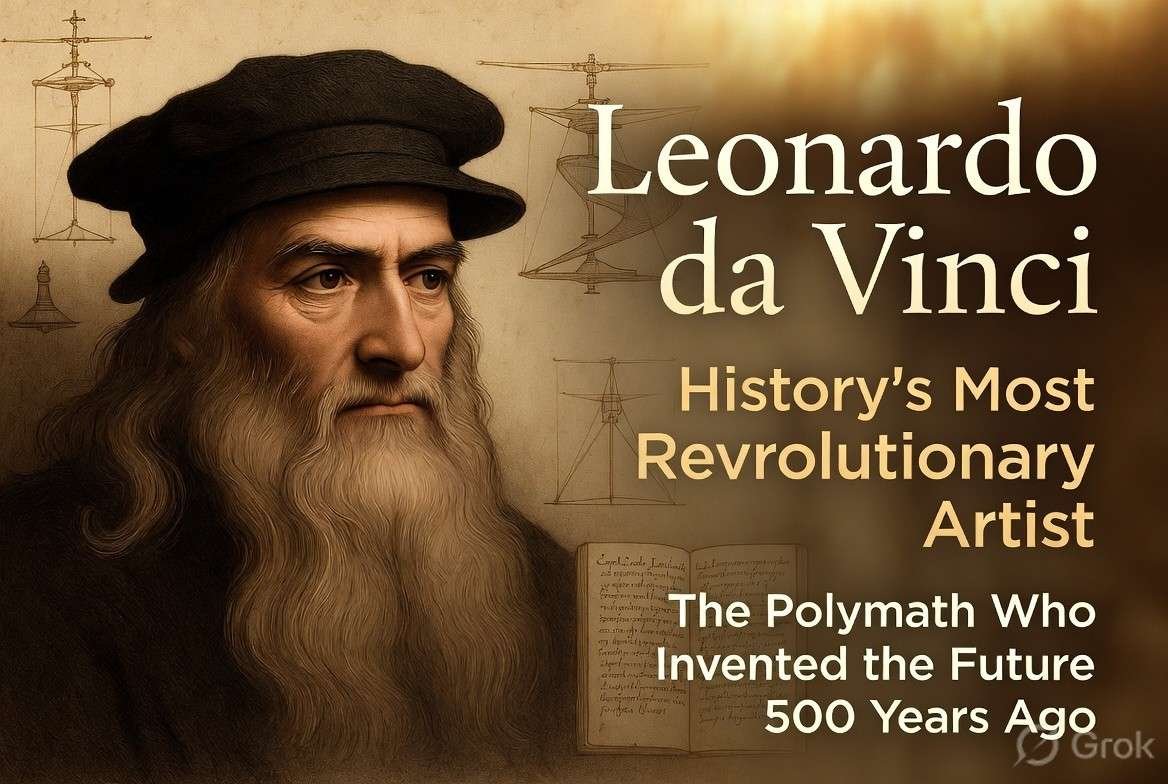
Imagine a man who sketched the human body with such precision that modern doctors still marvel at his accuracy—without X-rays or scanners. A visionary who designed flying machines, tanks, and parachutes centuries before airplanes or helicopters existed. An artist whose paintings hide secrets that continue to baffle experts. This isn’t science fiction. This is Leonardo da Vinci, the ultimate Renaissance genius whose ideas were so ahead of their time that Bill Gates once paid $30.8 million (over ₹4400 crore today) for one of his notebooks.
In this powerful motivational deep-dive (inspired by one of the internet’s most inspiring Hindi videos on the legend), we uncover not just da Vinci’s extraordinary achievements, but the mindset that made him a revolutionary force. His story isn’t about raw talent—it’s about relentless curiosity, fearless observation, and connecting dots others couldn’t even see.
The Codex Leicester: A Glimpse into the Future
At the heart of da Vinci’s genius lies the Codex Leicester, a 72-page notebook filled with his handwritten notes and sketches on science, nature, and technology. Purchased by Bill Gates, it reveals how Leonardo predicted modern inventions 500 years ago. He studied everything from the blue color of the sky to the mechanics of bird flight, recording observations that would later shape aviation and beyond.
His work wasn’t theoretical daydreaming. Da Vinci dissected bodies in graveyards at night, creating over 240 detailed anatomical sketches that match today’s medical knowledge. He loved birds so much he’d buy them from markets just to set them free—and then study their flight patterns frame-by-frame like a modern animator.
Inventions That Shaped the Modern World
Da Vinci didn’t just paint—he engineered the impossible:
- Flying machines and helicopters: His sketches of aerial screws and ornithopters directly influenced the first successful helicopter in 1940.
- Parachutes: A 2000 test jump proved his design worked perfectly.
- Tanks and war machines: Armored vehicles with 33-barreled organ guns that could fire in all directions.
- Aerial city maps: Drawn from a bird’s-eye (or satellite-like) perspective.
- Chariots and fighting vehicles: Early concepts of armored warfare.
He turned curiosity into prototypes, proving that true innovation comes from doing—building, testing, and iterating.
Masterpieces That Still Captivate
Da Vinci’s art was just as revolutionary. He spent 14 years painting the Mona Lisa using a brush so fine it was like a single hair. Many believe it hides coded secrets. His The Last Supper contains layered mysteries—one hidden image becomes visible only when you overlay and flip the artwork.
These weren’t quick commissions. They were obsessions born from deep observation of light, emotion, and human nature.
The 7 Life-Changing Lessons from Leonardo da Vinci
The real magic isn’t just his inventions—it’s the way he thought. Here are the motivational takeaways straight from his philosophy:
- Curiosity beats talent every time. Da Vinci wasn’t born a genius—he trained his mind through constant questioning and experimentation.
- Master the power of observation. Write down physical details, note reactions, experiment, and let ideas simmer in the “backend” of your mind.
- Everything is connected. Lungs resemble trees. Cities mirror brain maps. Combine unrelated fields (like art + engineering) to spark breakthroughs—just like today’s most successful startups.
- Action over fear. Get-rich-quick schemes lead to ruin. Real bravery shows in consistent effort. Overcome your mind’s love for comfort with humor and willpower.
- Take breaks for clarity. Step away from projects to see flaws and improvements with fresh eyes.
- Time feels longer when used wisely. A beautiful, purposeful life stretches beyond years.
- Learn like Leonardo: Build models. Practice daily. Ask “why” relentlessly. Nature follows rules—discover them through action.
Why Da Vinci’s Story Matters in 2026
In a world obsessed with quick hacks and viral fame, Leonardo reminds us that real success comes from deep work, patience, and insatiable curiosity. Whether you’re a student, creator, entrepreneur, or dreamer—his life proves one truth: Your next big idea is hiding in the connections you haven’t made yet.
Start small today. Observe something ordinary in a new way. Sketch an idea. Question everything. As da Vinci showed, one curious mind can literally change the course of history.
What will you invent, create, or discover? The future is waiting—and it started with a single observation 500 years ago.