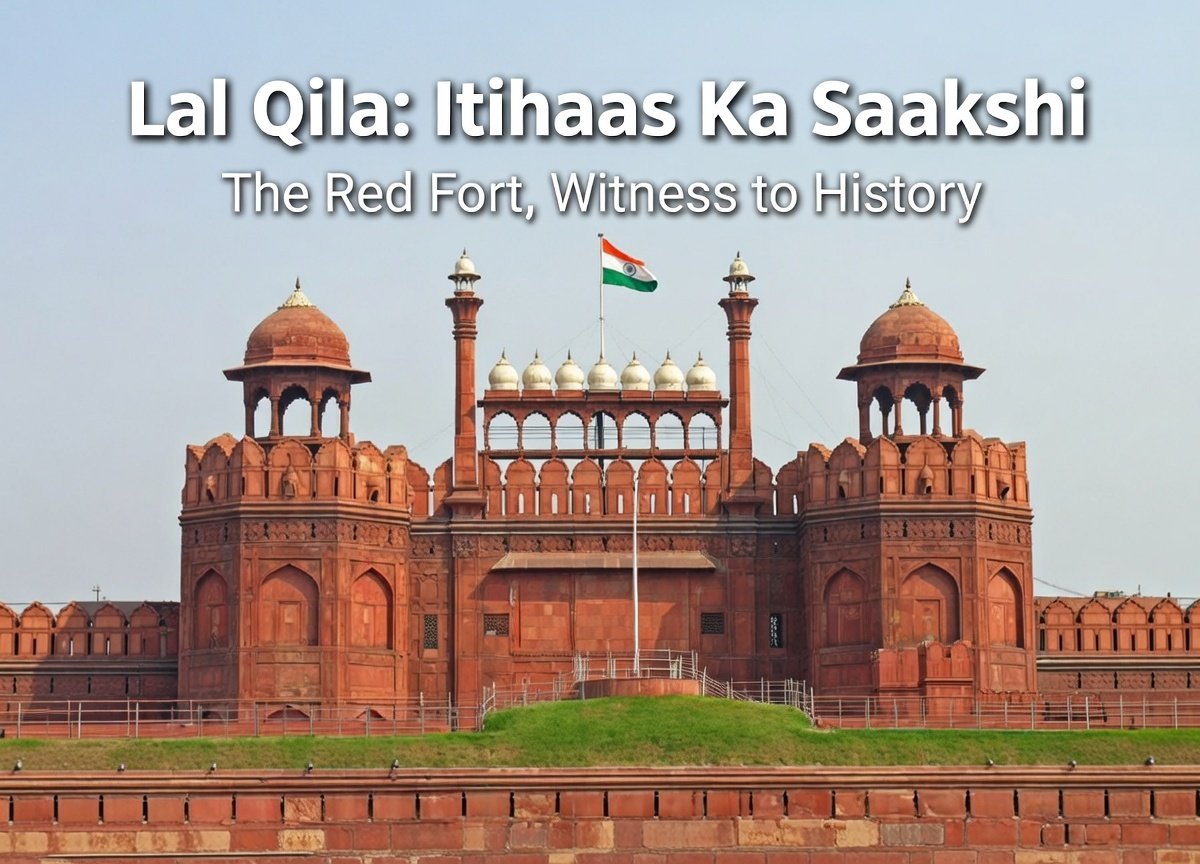
The Red Fort, or Lal Qila, stands as an enduring symbol of India’s rich Mughal heritage and its journey through centuries of change. This article draws inspiration from the insightful Doordarshan National documentary Lal Qila: Itihaas Ka Saakshi, produced by Rakesh Tyagi with script and voice by Sanjeev Upadhyaya. Uploaded in 2015, the video has garnered over 24 million views, highlighting the fort’s timeless appeal. It explores how the Red Fort has been a silent witness to pivotal moments in Indian history, from Mughal grandeur to modern independence.
The Mughal Origins: Shah Jahan’s Vision
Around 1600 AD, Mughal Emperor Shah Jahan decided to shift his empire’s capital from Agra to a new city in Delhi, which he named Shahjahanabad (now known as Old Delhi). Along with this ambitious urban project, he commissioned the construction of his palace, the Red Fort, or Lal Qila. The fort’s foundation was laid on May 12, 1639, and it took nearly a decade to complete, finishing in 1648. Designed by architect Ustad Ahmad Lahori—the same mastermind behind the Taj Mahal—the Red Fort is considered better planned than its predecessor, the Agra Fort, blending Persian, Timurid, and Indian architectural styles.
The fort’s massive red sandstone walls, rising up to 33 meters in height, enclose an area of about 120 acres and once housed a population of up to 3,000 people. These walls, varying from 16 meters on the river side to 33 meters facing the city, were originally adorned in red and white, symbolizing the opulence of the Mughal era. Shah Jahan personally oversaw the construction, ensuring it reflected the zenith of Mughal creativity with elements like intricate pavilions, geometrical gardens, and the Nahr-i-Behisht (Stream of Paradise), a water channel connecting various structures.
Architectural Marvels Within the Walls
The Red Fort’s layout is a masterpiece of Mughal planning. Key structures include the Diwan-i-Am (Hall of Public Audience), supported by 60 red sandstone pillars, and the more intimate Diwan-i-Khas (Hall of Private Audience), featuring a white marble pavilion. The complex also housed ornate mosques, baths, indoor canals, and projecting balconies, all designed with a fusion of Islamic prototypes and local traditions.
One of the fort’s innovative features was its integration with the adjacent Salimgarh Fort at the northeast corner, creating a comprehensive fortified complex. The Lahore Gate, the main entrance, leads to a bustling market area reminiscent of the Chandni Chowk that Shah Jahan established outside the fort. These elements not only served functional purposes but also influenced later architecture in regions like Rajasthan and Agra.
Historical Significance: From Empire to Independence
For nearly 200 years, the Red Fort served as the main residence of Mughal emperors, witnessing the empire’s peak and decline. However, after the Indian Rebellion of 1857, the British captured the fort, deposed the last Mughal emperor Bahadur Shah Zafar, and demolished several marble pavilions and gardens. Despite this, the fort’s core structure endured.
In modern times, the Red Fort became a symbol of India’s sovereignty. On August 15, 1947, India’s first Prime Minister, Jawaharlal Nehru, raised the national flag from its ramparts, a tradition that continues every Independence Day. Recognized as a UNESCO World Heritage Site in 2007, it represents the culmination of Mughal architectural development and its lasting impact on Indian culture.
Why the Red Fort Endures as a Witness to History
As depicted in the Doordarshan documentary, the Red Fort is more than a monument—it’s a living testament to India’s layered past, from Mughal splendor to colonial struggles and national pride. Its walls have echoed with the commands of emperors, the cries of revolutionaries, and the cheers of free citizens. Today, it attracts millions of visitors annually, offering a glimpse into the architectural ingenuity and historical depth that define India.
Whether you’re a history enthusiast or a casual traveler, a visit to the Red Fort in Delhi is a journey through time. Explore its halls, gardens, and museums to truly appreciate why it remains an iconic landmark.