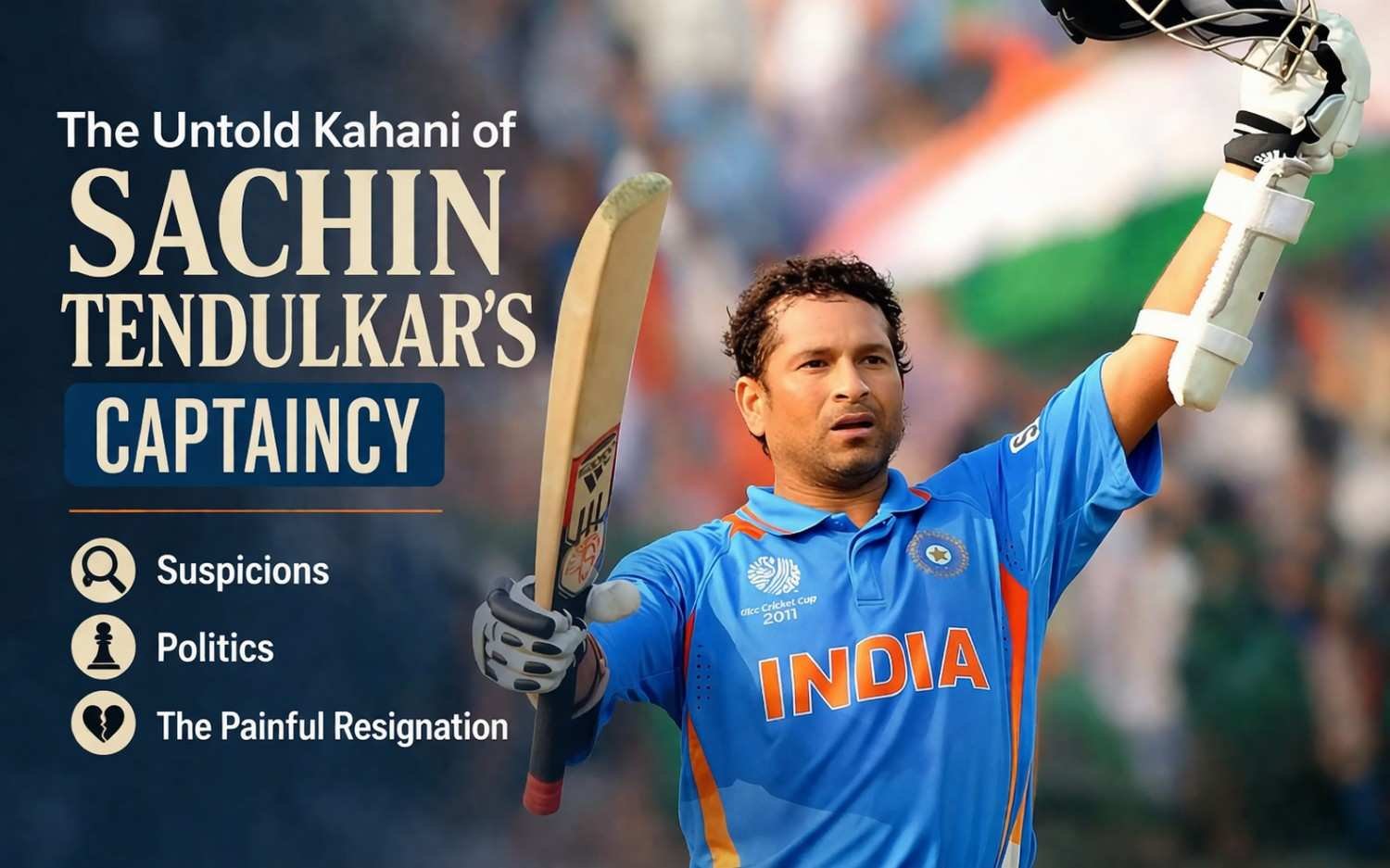
In the glittering world of Indian cricket, few stories are as heartbreaking yet fascinating as Sachin Tendulkar’s captaincy saga. The man who carried the hopes of a billion fans on his bat was twice handed the leadership of Team India — and twice saw it slip away amid controversies, lack of support, and deep personal doubts. Sports Tak’s popular Kahaani series, narrated by Vikrant Gupta, dives deep into this chapter, revealing why Sachin harboured suspicions about certain teammates and ultimately walked away from the captain’s armband forever.
The Rise of the Captain-in-Waiting
By the mid-1990s, Sachin Tendulkar wasn’t just India’s best batsman — he was the undisputed future of the team. After India’s disappointing 1996 World Cup campaign under Mohammad Azharuddin, everyone assumed Sachin would take over as captain. The young maestro had already earned the vice-captaincy and was widely seen as the natural successor.
In 1996, Sachin finally got his chance in the Delhi Test against Australia. But what should have been the start of a glorious era turned into a short and turbulent stint lasting just 12 months.
First Stint: Suspicion, Isolation, and Sudden Removal
Sachin quickly realised that captaincy in Indian cricket wasn’t just about tactics on the field — it was about navigating politics off it. According to the Kahaani episode, he developed suspicions about some players in the dressing room. There was a clear communication gap with the outgoing captain Azharuddin, and Sachin felt he couldn’t fully trust everyone around him.
The selectors, worried that a strong captain like Sachin might become too powerful (comparisons were drawn to Imran Khan), gave him little backing. In a shocking move, Sachin was removed from captaincy without even being informed personally. One day he was captain; the next, he wasn’t. The decision came under coach Madan Lal, and it left a deep scar.
Yet, even as captaincy was taken away, Sachin’s batting continued to dazzle. He remained the team’s biggest star — but the experience left him wary.
Second Stint (Post-1999 World Cup): Hope, Heartbreak, and Kapil Dev
After the 1999 World Cup, Azharuddin was still captain, but selectors persuaded a reluctant Sachin to take charge again. Chief selector Ajit Wadekar convinced him, and Sachin agreed with certain conditions about team roles. Expectations soared when the legendary Kapil Dev was appointed coach. Fans dreamed of the ultimate dream team: Sachin as captain, Kapil as coach.
The new era began promisingly with a Test series against New Zealand in India. India won the series, but cracks appeared quickly. In the Ahmedabad Test, India chose not to enforce the follow-on against New Zealand — a decision that sparked huge controversy and allowed the visitors to escape with a draw.
Then came the disastrous Australia tour. India lost all three Tests, each by a narrow margin of around 30 runs. Sachin was the only shining light with the bat, but the defeats were demoralising. BCCI secretary Jaywant Lele’s public criticism only added to the pressure.
Growing Friction with Coach & Administration
Sachin later revealed in his autobiography that he received almost no strategic support from Kapil Dev. The captain-coach relationship, once full of promise, turned frosty. Matters worsened during an ODI tri-series where selectors picked senior players against the wishes of the captain and coach. Sachin and the team management were furious, even threatening non-participation. India managed just one win against Pakistan in the series.
By the time South Africa toured India, the team was demoralised. Reports criticised the absence of senior players, and BCCI officials’ behaviour was reportedly affecting Sachin’s focus and batting. The same feelings of isolation and lack of support that haunted his first stint returned.
The Resignation That Shocked Everyone
After the South Africa series (which India lost 2-0), Sachin had had enough. In a clear and emotional statement, he announced: “From today onwards, I will never captain India after this series.” Sourav Ganguly was named the new ODI captain, and Sachin never wore the captain’s armband again.
The Kahaani episode highlights how the constant politics, suspicion in the dressing room, and lack of backing from selectors and officials took a heavy toll on Sachin — both as a leader and as a batsman. He simply wanted to focus on what he did best: scoring runs for India.
Why This Story Still Matters
Sachin Tendulkar’s captaincy record reads 4 wins in 25 Tests — not spectacular by any means. But the real story isn’t in the numbers. It’s about a once-in-a-generation talent who was let down by the system he was supposed to lead. The suspicions he had about certain players later found context in the 2000 match-fixing scandal that rocked Indian cricket (though the video carefully avoids naming names).
Vikrant Gupta’s narration in the Sports Tak Kahaani episode brings this drama alive with rare insights, timeline details, and Sachin’s own reflections from his book. It reminds us that behind the Master Blaster’s calm exterior was a man who fought battles far bigger than any bowler.
Watch the full episode here: KAHAANI: क्यों SACHIN को कुछ खिलाड़ियों पर था शक
Indian cricket has come a long way since then. Modern captains enjoy far more support and professionalism. But Sachin’s story remains a powerful reminder of how fragile leadership can be when politics overrides passion.
What do you think — should Sachin have been given more time and support as captain? Or was stepping down the best decision for both him and Indian cricket? Drop your thoughts in the comments!