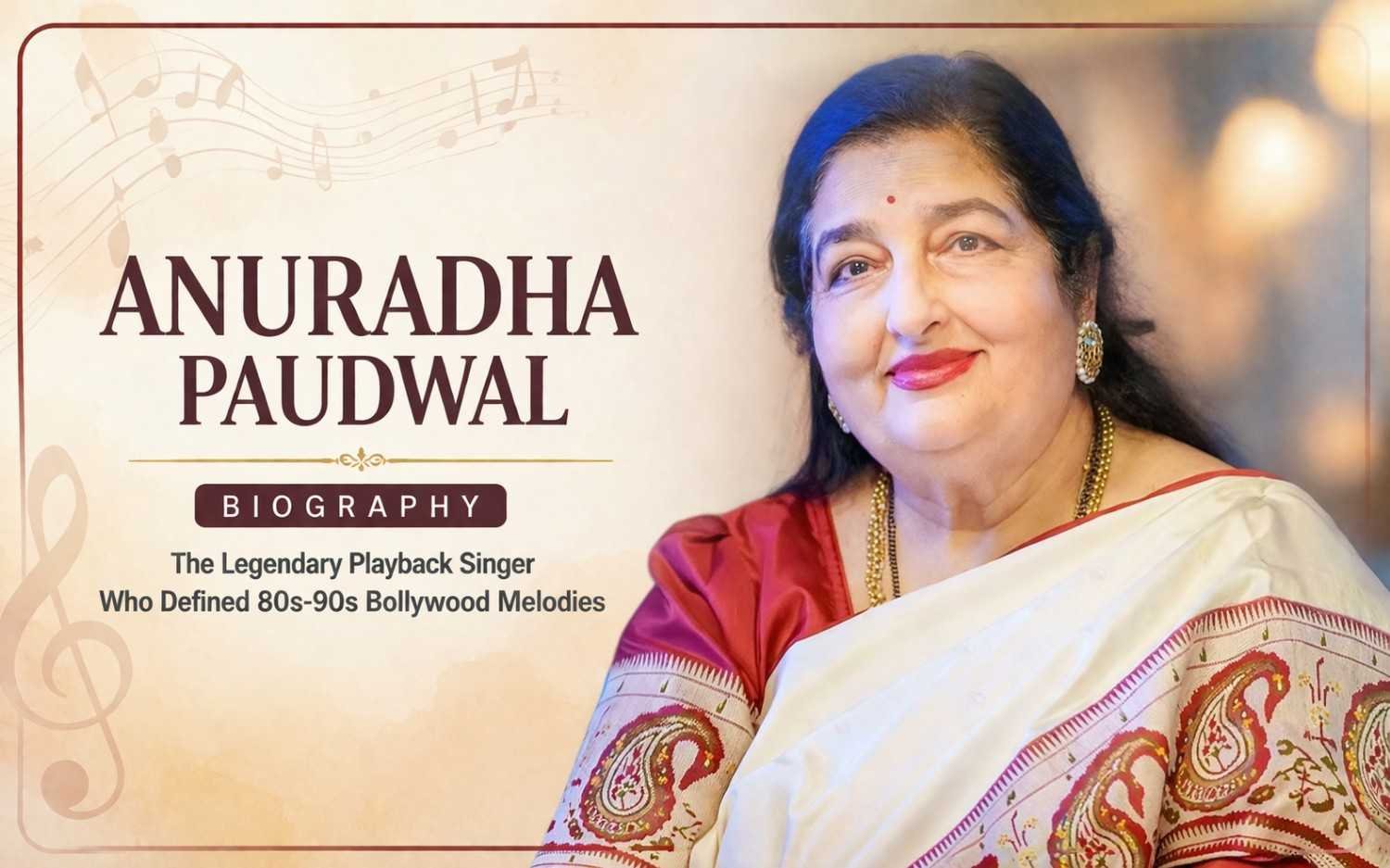
Anuradha Paudwal’s voice is more than just sound—it’s the heartbeat of an entire era in Indian cinema. From soul-stirring romantic duets to chart-topping dance numbers and millions-selling devotional bhajans, she has enchanted generations for over five decades. With classics like “Dheere Dheere Se Meri Zindagi Mein Aana,” “Dhak Dhak Karne Laga,” “Tu Mera Jaanu Hai,” and “Tera Naam Liya,” Anuradha Paudwal became the voice of 80s and 90s Bollywood heroines. Yet behind the timeless hits lies a story of early struggles, family tragedies, industry rivalries, and an unwavering turn toward devotion. This in-depth biography draws from her remarkable journey, revealing the woman behind the legendary voice.
Early Life: From Karwar Roots to Mumbai Dreams
Born Alka Nadkarni (also referred to as Alka Natkar) on October 27, 1954, in Karwar, Karnataka, to a Konkani Hindu family, Anuradha’s childhood was shaped by both ambition and adversity. The family later moved to Mumbai, where her father worked in a government job. As a young girl, Anuradha dreamed of becoming a doctor, but destiny had other plans.
At just four years old, she attended a live concert by the legendary Lata Mangeshkar. The experience left an indelible mark. Secretly, she began imitating Lata’s songs at home, even though her conservative family viewed the film industry as unsuitable. A severe bout of pneumonia at age four temporarily robbed her of her voice, but when it returned, it had transformed into the sweet, melodious tone fans adore today. During recovery, she listened to Lata’s recordings of the Bhagavad Gita, further deepening her love for music and spirituality.
A Young Marriage and First Steps into Music
At the tender age of 16, Anuradha married Arun Paudwal, who was 27 and already working as an assistant to music maestro S.D. Burman. The couple had three children—son Aditya, daughter Kavita (now a devotional singer), and a son who passed away tragically at just one month old. Arun played a pivotal role in launching her career. He secretly recorded her voice for a line in the 1973 film Abhimaan (composed by S.D. Burman). Impressed, Burman gave her the break, marking her official playback debut.
Breakthrough and Rise to Stardom (1980s–1990s)
Success didn’t come overnight. Early years were filled with struggle, but everything changed in 1983 with Subhash Ghai’s blockbuster Hero. Songs like “Tu Mera Jaanu Hai” and “Tu Mera Dilbar Hai” catapulted Anuradha into the spotlight. She quickly became a go-to singer for composers Laxmikant-Pyarelal and Kalyanji-Anandji.
The 80s and 90s were her golden era. Blockbusters like Meri Jung, Ram Lakhan, Tezaab, Beta, and Aashiqui featured her voice prominently. Iconic tracks include:
- “Dhak Dhak Karne Laga” (Beta)
- “Dheere Dheere Se Meri Zindagi Mein Aana” and “Tera Naam Liya” (Aashiqui)
- “Maine Pyar Tumhi Se Kiya Hai”
She recorded over 1,000 film songs and 1,500+ bhajans in multiple languages. Her duets with legends like Mohammed Rafi, Kishore Kumar, and contemporaries Alka Yagnik and Asha Bhosle became evergreen. Music director O.P. Nayyar famously called her “the new Lata Mangeshkar.” Between 1991 and 1993, she swept the Filmfare Award for Best Female Playback Singer three years in a row.
Her exclusive association with T-Series and Gulshan Kumar brought massive commercial success. Cassettes flew off shelves, and her voice became synonymous with both romantic ballads and foot-tapping hits.
Personal Challenges, Heartbreaks, and Industry Politics
Behind the success were profound personal losses. In 1991, her husband Arun died in a car accident. Their son Aditya later passed away at age 35 due to kidney failure. Anuradha also faced intense industry rivalry. Songs were reportedly replaced by Lata Mangeshkar or Asha Bhosle at the last minute, and she endured professional setbacks, including a public incident where Asha Bhosle allegedly had Arun removed from a studio. There were also reported tensions with Alka Yagnik.
A close professional relationship with T-Series founder Gulshan Kumar sparked rumors, especially after his tragic murder in 1997. Anuradha distanced herself from mainstream films around 2000, focusing instead on bhajans. One devotional album reportedly sold 90,000 cassettes in a single hour—an astonishing feat.
The Devotional Turn and Later Years
Post-2000, Anuradha Paudwal found solace and renewed purpose in devotional music. Her bhajans and spiritual songs resonated deeply with audiences across India. A devout Hindu, she performs daily havan (fire rituals) and has openly supported Hindutva causes, including membership in the BJP. She received the Padma Shri in 2017, along with multiple Filmfare Awards and a National Film Award, cementing her status as a national treasure.
Today, she lives with her daughter Kavita in Mumbai. Despite the sorrows, her faith remains her anchor. The singer has overcome personal tragedies through music and spirituality, emerging stronger and more respected than ever.
Legacy: A Voice That Continues to Inspire
Anuradha Paudwal’s journey—from a quiet Konkani girl secretly singing Lata songs to one of Bollywood’s most celebrated playback singers—is a testament to talent, resilience, and devotion. Whether it’s the passion in her film songs or the purity in her bhajans, her voice has touched millions and continues to do so.
Her story reminds us that true legends aren’t defined only by chart-toppers but by how they rise above life’s toughest challenges. In an industry known for fleeting fame, Anuradha Paudwal’s melody endures—timeless, soulful, and unforgettable.
Did you know? Anuradha Paudwal has recorded in several regional languages and her devotional work has outsold many of her film albums. Which is your favorite Anuradha Paudwal song? Drop it in the comments below!